


Corporate governance
Corporate governance report
CPH Group’s ability to create value over the long term is based on responsible corporate governance that incorporates the interests of customers, employees, shareholders and other stakeholders.
CPH Group operates internationally in different countries and markets with different legal systems. Compliance with applicable legislation is ensured in full. The company’s long-term success is dependent on proper management and adherence to high ethical standards, which are implemented commensurate with its size and structure. This includes responsible corporate governance based on the Swiss Code of Best Practices for Corporate Governance of Economiesuisse. Corporate governance is aligned with the group’s Guiding Principles, Articles of Incorporation and Organizational Regulations, plus the Codes of Conduct of the individual divisions, which can be downloaded from the website at https://cph.ch/investors/documentation/ under “Articles of incorporation, regulations and description of duties,” (some available only in German).
1. Group structure and shareholders
1.1 Group structure
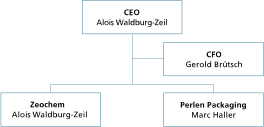
CPH Group consists of two independent business divisions: Zeochem and Perlen Packaging. The parent company, CPH Group, is headquartered in Perlen/Root, Switzerland. The overview of subsidiaries within the scope of consolidation can be found in the notes to the consolidated financial statements. CPH Group is managed by the CEO, and the divisions are managed by their respective heads. The Group Executive Board is comprised of the CEO, the CFO and the heads of the respective divisions (CEO and Head of Zeochem in tandem).
Organization chart as of 31 December 2025
CPH Group is the only listed company in the scope of consolidation. Its registered shares (Swiss securities no. 162471, ISIN CH0001624714) are listed on the SIX Swiss Exchange. Market capitalization as of 31 December 2025 amounted to CHF 415 million.
1.2 Significant shareholders
As of 31 December 2025, 1 228 shareholders holding the following number of shares were entered in the share register:
386 066 shares or 6.4 % were not entered in the share register as of 31 December 2025 (unregistered shares).
Significant shareholders holding more than 3 % of voting rights are known to the company as follows:
The two anchor shareholders, Swiss Industrial Finance AG and Elly Schnorf-Schmid Foundation, have concluded a shareholders’ agreement to form a stable shareholder base and together hold 33.6 % of shares. Swiss Industrial Finance AG belongs to the family branch of Chairman of the Board of Directors Peter Schaub, who represents the shareholder group. The free float amounts to 57.2 % of shares.
Disclosure notices from the reporting year as well as from previous years can be found on the SIX Exchange Regulation website at https://www.ser-ag.com/en/resources/notifications-market-participants/significant-shareholders.html#/.
1.3 Cross-shareholdings
There are no cross-shareholdings.
2. Capital structure
2.1 Ordinary capital
The issued share capital of the company amounts to CHF 900 000 and is divided into 6 000 000 fully paid-up registered shares with a nominal value of CHF 0.15 each.
2.2 Capital band and conditional capital
The company has no outstanding capital band or conditional capital.
2.3 Changes in capital
There were no changes in capital in the 2023 and 2025 financial years. In the 2024 financial year, there was a change in capital resulting from the spin-off of the Paper Division, which reduced the share capital by CHF 300 000 from CHF 1 200 000 to CHF 900 000. The capital reduction was carried out as follows: a) by reducing the nominal value of the 6 000 000 registered shares with a par value of CHF 0.20 each to CHF 0.15 each; and b) by allocating the amount of CHF 300 000 by which the share capital was reduced to statutory capital reserves.
2.4 Shares
The share capital of CHF 0.9 million is divided into 6 000 000 fully paid-up registered shares with a nominal value of CHF 0.15 each. Each share entered in the company’s share register conferring the right to vote has one vote at the General Meeting. There are no restrictions on transferability or voting rights, subject to the restrictions set out in section 2.6.
2.5 Participation and dividend-right certificates
The company has not issued any participation or dividend-right certificates.
2.6 Limitations on transferability
The Board of Directors shall, upon request, enter purchasers of registered shares in the share register as shareholders with the right to vote. The Board of Directors may refuse to enter the purchaser if they do not expressly declare that they have acquired the shares in their own name and for their own account or if they provide false information, provided that the registered shares to be entered account for more than 3 % of the respective outstanding share capital. The Articles of Incorporation do not stipulate any further restrictions on the transferability of shares.
2.7 Convertible bonds and options
CPH Group has no outstanding convertible bonds and it has not issued any options to persons inside or outside the company.
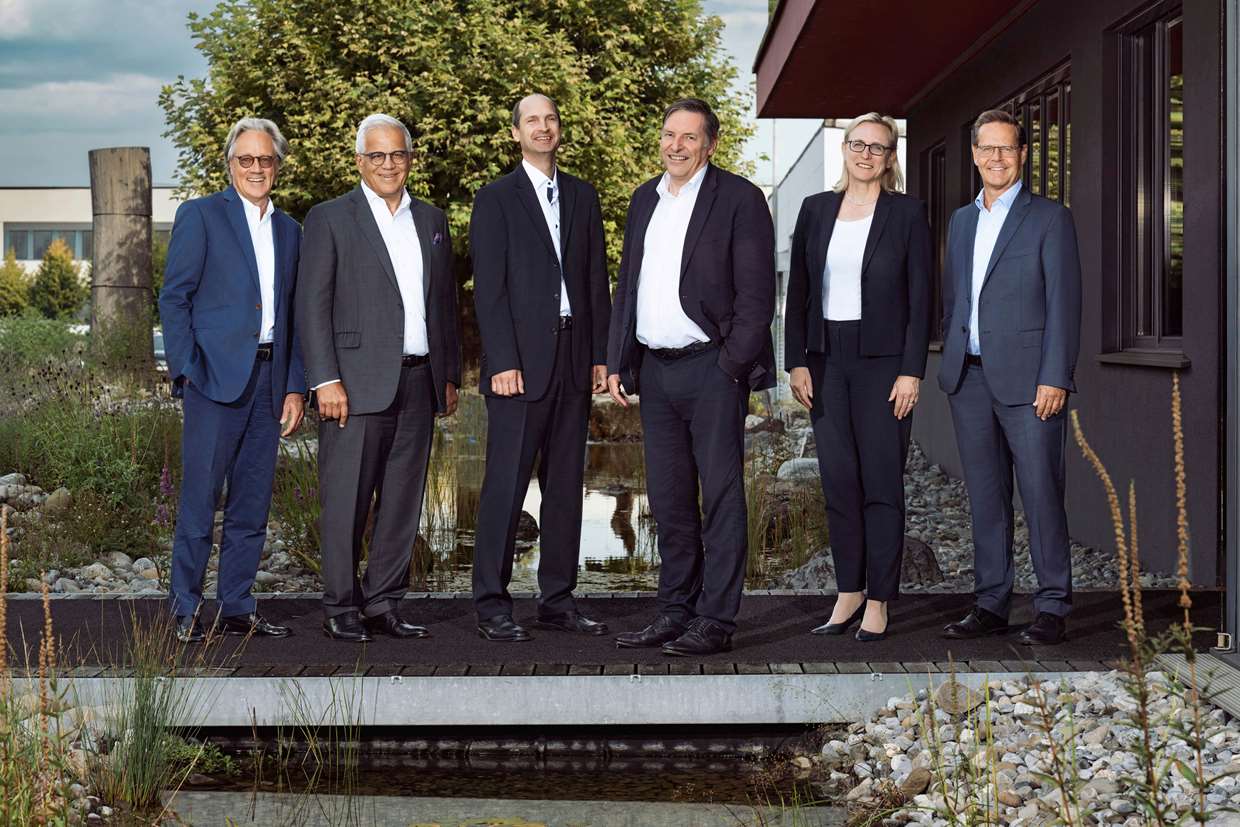
Board of Directors as of 31 December 2025 (from left to right): Christian Wipf, Tim Talaat, Manuel Werder, Peter Schaub, Claudine Mollenkopf, Kaspar W. Kelterborn
3. Board of Directors
3.1 Members of the Board of Directors
The Board of Directors of CPH Group consists of a minimum of three and a maximum of nine members. As of 31 December 2025, the Board of Directors was comprised of six members. Chairman of the Board of Directors Peter Schaub represents the shareholder group of Swiss Industrial Finance AG and Elly Schnorf-Schmid Foundation, with 33.6 %. The other five members (83 %) are independent, meaning that they do not represent a shareholder holding more than 3 % of capital or votes. In addition, they did not or do not currently work for the company in an executive capacity, nor have they done so in the last five years, and they do not have an overlapping mandate with a member of the Group Executive Board.
1 Peter Schaub represents the group of shareholders of Swiss Industrial Finance AG and Elly Schnorf-Schmid Foundation.
As is evident from their backgrounds below, all members of the Board of Directors have extensive management experience in international industrial companies or other companies. The Board of Directors is thus made up of members possessing a wide range of experience and skills:
The proportion of women on the Board of Directors is 17 %, which is below the statutory guideline of 30 % applicable from 2026 onward. The pool of suitable female candidates in the industry is still small. Criteria such as track record, experience and competence are also relevant alongside diversification aspects. The current proportion of women is the result of careful consideration that takes into account all the skills required for a position on the Board of Directors. CPH Group will strive to meet the guideline to the best of its ability moving forward as part of its succession planning.
3.2 Professional background, other activities and vested interests
Peter Schaub
Peter Schaub, lic. iur., attorney-at-law, born in 1960 and Swiss national, has been Chairman of the Board of Directors since 2010. He has been a consultant to Weber Schaub & Partner AG, Tax and Legal Consultancy, Zurich, since 2025. Peter Schaub is Chairman of the Board of Directors of Scobag Privatbank AG, Basel; Chairman of the Board of Directors of Zindel Immo Holding AG, Chur; Chairman of the Board of Directors of Mobimo AG, Lucerne; Chairman of the Board of Directors of Swiss Industrial Finance AG, Zurich; Chairman of the Board of Directors of Perlen Industrieholding AG, Perlen; Deputy Chairman of the Board of Directors of UBV Holding AG, Uetikon; and member of the Board of Directors of Rüegg Cheminée Holding AG, Zumikon. He is member of the Board of Directors of various other unlisted companies and trustee of several foundations.
From 1994 to 2024, he was a partner at Weber Schaub Partner AG, Tax and Legal Consulting, Zurich; from 1990 to 1993, tax commissioner at the Zurich Cantonal Tax Office; and from 1987 to 1988, trainee at law firm Schellenberg Wittmer, Zurich.
Tim Talaat
Tim Talaat, MSEE and MBA, born in 1960 and Swiss national, has been Deputy Chairman of the Board of Directors since 2015 and Chairman of the Personnel and Compensation Committee since 2020. He is the majority shareholder and Chairman of the Board of Directors of SIHAG Swiss Industrial Holding AG, Uetikon (this company is in no way connected to Swiss Industrial Finance AG); Deputy Chairman of the Board of Directors of Perlen Industrieholding AG, Perlen; and Chairman of the Advisory Board of Single Group GmbH, Hochdorf (DE).
From 2009 to 2015, he was CEO of Looser Holding AG, Arbon; from 2003 to 2007, CEO of SR Technics Switzerland; and from 1996 to 2003, member of the Executive Board of SR Technics Group, Zurich Airport.
Kaspar W. Kelterborn
Kaspar W. Kelterborn, lic. oec. HSG, born in 1964 and Swiss national, has been Chairman of the Finance, Auditing and Sustainability Committee since 2015; member of the Board of Directors of Burckhardt Compression Holding AG, Winterthur; member of the Board of Directors of EMS-CHEMIE AG, Domat/Ems; member of the Board of Directors of Karl Bubenhofer AG, Gossau (SG); member of the Board of Directors of Wipf Holding AG, Brugg; member of the Board of Directors of Perlen Industrieholding AG, Perlen; and owner of Kelterborn Advisory AG, Wangen (SZ).
In 2022, he was Group CFO ad interim and member of the Executive Board of Dormakaba Group, Rümlang; from 2006 to 2021, Group CFO and member of the Executive Board of Conzzeta Group, Zurich; and from 2002 to 2005, Group CFO and member of the Executive Board of Unaxis Group, Pfäffikon. From 1996 to 2002, he held senior positions in finance and controlling at home and abroad for Clariant Group, Muttenz.
Claudine Mollenkopf
Claudine Mollenkopf, Dr rer. nat., born in 1966, is a German and French national. She has been Chief Operating Officer Advanced Technologies at Evonik Industries AG since 2025 and is member of the Executive Board of Evonik Industries AG, Essen, and member of the Executive Board of Evonik Operations GmbH, Essen. Claudine Mollenkopf has more than 30 years of experience in the chemical industry.
From 2022 to 2025, she was Division Head Specialty Additives at Evonik Industries AG, Essen; from 2019 to 2022, Senior Vice President and General Manager Silicas at Evonik Operations GmbH, Essen; from 2011 to 2019, member of the Executive Committee of Orion Engineered Carbons S.A., Luxembourg; and from 2018 to 2019, President of Orion Engineered Carbons France SAS, Berre L’Etang. From 1996 to 2010, she held various senior positions at Evonik Group, most recently as General Manager of the Business Line Rubber/MRG Industries.
Manuel Werder
Manuel Werder, lic. iur., LL.M. attorney-at-law, born in 1974 and Swiss national, has been Partner since 2015 and Head of Finance, Risk and Compliance at law firm Niederer Kraft Frey AG, Zurich, since 2024. He is member of the Board of Directors of UBV Holding AG, Uetikon; member of the Board of Directors of Perlen Industrieholding AG, Perlen; and member of the Board of Directors of various other unlisted companies and trustee of several foundations.
From 2010 to 2015, he was Senior Associate at Niederer Kraft Frey AG, Zurich; from 2007 to 2008, Secondment at Allende & Brea Abogados, Buenos Aires; from 2004 to 2007, Associate at Niederer Kraft Frey AG, Zurich; and from 2002 to 2004, Foreign Associate at Fox Horan & Camerini LLP, New York.
Christian Wipf
Christian Wipf, lic. oec. HSG, born in 1957 and Swiss national, is Chairman and Delegate of the Board of Directors at Wipf Holding AG, Brugg, and Chairman of the Board of Directors of various subsidiaries of Wipf Group.
From 1997 to 2020, he was CEO of Wipf Group, Brugg; from 2001 to 2007, CEO of Wipf AG, Volketswil; and from 1991 to 1997, member of the Executive Board of Seetal Schaller AG, Brugg. From 1982 to 1991, he held various management positions at Philips AG, Zurich, and Philips Electronics Ltd, Montreal.
3.3 Rules in the Articles of Incorporation governing the number of permissible activities pursuant to Art. 626 para. 2 no. 1 CO
According to Art. 21 of the Articles of Incorporation, members of the Board of Directors may hold up to 15 additional mandates, no more than three of which may be in listed companies. These restrictions do not apply to:
- Mandates in legal entities that are controlled by the company or control the company.
- Mandates in associations and foundations as well as employee welfare foundations. Each member of the Board of Directors may hold up to five such mandates.
- Mandates in joint ventures involving the company that are not controlled by the company. Each member of the Board of Directors may hold up to five such mandates.
Mandates include activities of members of the Board of Directors in the supreme management or administrative bodies of legal entities that are required to be entered in the Swiss commercial register or a corresponding register abroad, and that are not controlled by the company or do not control the company. Mandates in different legal entities under joint control count as one mandate. No member of the Board of Directors holds more than the maximum number of external mandates stipulated in the Articles of Incorporation.
3.4 Election and term of office
The date on which the individual members were elected for the first time is set out in section 3.1. In accordance with Art. 14 of the Articles of Incorporation, the members of the Board of Directors are elected individually by the General Meeting for a term of office of one year; re-election is possible. The mandate ends no later than at the General Meeting for the year in which the member in question turns 70.
3.5 Internal organization structure
The organization of the Board of Directors is governed by the law, the Articles of Incorporation and the Organizational Regulations. The latter two can be viewed on the CPH Group website: https://cph.ch/investors/documentation/ (under “Articles of Incorporation, regulations and description of duties,” Organizational Regulations available only in German).
The Board of Directors meets as often as business requires, but at least five times a year. The Board of Directors shall be quorate if the majority of its members are present. Resolutions of the Board of Directors are passed by a majority of the votes cast. The Chair participates in the vote and has the casting vote. In the reporting year, the Board of Directors met a total of six times over five half-day meetings and one full-day strategy meeting. Meetings were attended in person or, in exceptional cases, by video conference. The attendance rate for the meetings was 100 %.
At the strategy meeting, the Board of Directors deals with strategic issues and medium-term development plans, both for the company as well as for Zeochem and Perlen Packaging. The entire Group Executive Board takes part, supplemented as the topic requires by members of the management teams of Zeochem and Perlen Packaging. The Chair of the Board of Directors or their deputy calls the meetings, chairs the discussions and ensures the taking of minutes. They represent the Board of Directors vis-à-vis external bodies. The Chair of the Board of Directors reports directly to the CEO. They have no special powers beyond this unless individual powers are delegated to them by the Board of Directors, or if presented with urgent cases requiring an immediate decision.
The Board of Directors has established two permanent committees: the Finance, Auditing and Sustainability Committee and the Personnel and Compensation Committee. Each committee consists of at least three non-executive members of the Board of Directors. The members of the Finance, Auditing and Sustainability Committee meet at least three times a year, while the members of the Personnel and Compensation Committee meet at least twice a year. The committees do not make any decisions themselves; they primarily serve a pre-advisory role with the intention of making the meetings of the Board of Directors more efficient and facilitating swift, well-founded decisions. The Board of Directors regularly reviews the composition of its committees.
The Finance, Auditing and Sustainability Committee
Kaspar W. Kelterborn (Chairman), Peter Schaub and Manuel Werder constitute the Finance, Auditing and Sustainability Committee. Peter Schaub works as a representative of the shareholder group of Swiss Industrial Finance AG and Elly Schnorf-Schmid Foundation. The other members of the Finance, Auditing and Sustainability Committee are independent. The CEO and CFO are guests at the meetings. In the reporting year, the committee held three half-day meetings and one conference call. The attendance rate for the meetings was 100 %. The members of the Finance, Auditing and Sustainability Committee are appointed by the Board of Directors. The tasks of the Finance, Auditing and Sustainability Committee include, in particular:
- Reviewing the structure of finance and accounting processes for appropriateness, reliability and effectiveness
- Reviewing the annual and semi-annual financial statements as well as other financial information intended for publication; defining policies, quality standards and informational content
- Monitoring the assessment of business risks and reviewing risk management practices
- Monitoring investment and hedging policies
- Monitoring and assessing the effectiveness of the internal control system (ICS)
- Monitoring business activities to ensure compliance with BoD resolutions, corporate policy principles and directives, and applicable legal provisions, in particular stock exchange legislation, as well as implementation of the same
- Reviewing the performance, independence and remuneration of the auditors and Group auditors (external auditors) and submitting a voting proposal to the Board of Directors or General Meeting; approving the audit plan; handling the audit reports; and monitoring implementation of the recommendations made by the external auditors
- Advising the Board of Directors on matters relating to sustainability and climate strategy
- Monitoring the real estate strategy
The Personnel and Compensation Committee
Tim Talaat (Chairman), Claudine Mollenkopf, Peter Schaub (except concerning his own remuneration) and Christian Wipf constitute the Personnel and Compensation Committee. Peter Schaub works as a representative of the shareholder group of Swiss Industrial Finance AG and Elly Schnorf-Schmid Foundation. The other members of the Personnel and Compensation Committee are independent. Three half-day meetings were held in the reporting year. The attendance rate for the meetings was 100 %. The members of the Personnel and Compensation Committee are elected individually by the General Meeting for a term of office of one year; re-election is possible. The CEO is a permanent guest at committee meetings, except when their own remuneration or other matters relating to them are the subject of discussion. The duties of the Personnel and Compensation Committee include, in particular:
- Drafting the guidelines governing the remuneration policy and remuneration system of CPH Group for the attention of the Board of Directors, in particular the principles governing the remuneration of the Board of Directors and Group Executive Board
- Submitting proposals to the Board of Directors regarding the remuneration (including components of this remuneration) of the Board of Directors and members of the Group Executive Board
- Reviewing the performance and annual target achievement of the CEO and members of the Group Executive Board; submitting proposals to the Board of Directors regarding the fixed and variable remuneration of the same
- Monitoring implementation of the personnel and remuneration policy and salary progression at CPH Group
3.6 Delegation of responsibilities
Pursuant to Art. 716a CO, the Board of Directors has non-transferable and inalienable duties. The delegation of responsibilities and cooperation between the Board of Directors, its committees and the Group Executive Board are governed by the Organizational Regulations (https://cph.ch/investors/documentation/ under “Articles of Incorporation, regulations and description of duties,” available only in German). The Board of Directors has the following duties at the group level:
- Defining the Guiding Principles and general business conduct
- Defining the group structure, group policy, group objectives and general group strategy, as well as the strategic growth areas
- Formulating targets with regard to key operating indicators, financing policy and return on investment
- Allocating resources and making decisions on how funds are used within CPH Group
- Appointing the Boards of Directors of the subsidiaries
- Approving group company agreements on strategic cooperation, both between each other or with other companies
- Deciding on adding or discontinuing major business lines
- Deciding on hiring and dismissing members of the Group Executive Board
- Exercising supervisory authority over the group’s management, specifically with regard to compliance with the law, Articles of Incorporation, regulations and directives, and implementation of resolved measures
- Defining the principles of remuneration and setting the remuneration of the members of the Group Executive Board
- Reviewing the risk management system and business risks
The Board of Directors exercises the following duties for the divisions:
- Defining divisional objectives and divisional strategies
- Deciding on the establishment and closure of operating facilities and branches
The Board of Directors regularly performs a self-evaluation of its own work and that of its committees.
3.7 Information and control instruments vis-à-vis the Group Executive Board
The Chairman of the Board of Directors supports the CEO in performance of their duties and implementation of the strategy through regular interaction and dialog. The Board of Directors supervises the Group Executive Board through structured reporting and controlling processes. The Board of Directors receives a detailed written report every month on the course of business, financial results, market performance, impending risks and important events. The CEO also explains current business trends and all matters relevant for the group at each meeting of the Board of Directors.
Risk management
As an international company, CPH Group is exposed to various financial and non-financial risks that are inextricably linked to the business activities of CPH Group. The defined risks refer in the broadest sense to the risk of not achieving the financial, operational or strategic objectives that have been set. It is crucial for the long-term success of the company to identify and analyze risks effectively and to eliminate or limit these using suitable control measures.
CPH Group uses a professional risk management system based on a uniform, group-wide methodology. The risk management process comprises the identification, evaluation, management and monitoring of all material risks and opportunities. Risk management software is used to support these processes, which in turn enables structured recording and consistent assessment of all risk types. Risks are documented, responsibilities are assigned and risk management measures are tracked centrally via the system. The data collected in this way forms the basis for regular reporting to the Board of Directors and Group Executive Board.
Assessment of material risks
The material risks identified in the reporting year included geopolitical risks and changes to local laws and regulations, inflation and the associated increases in input costs, the security of IT systems, and changes in the market environment of an economic nature or changes in the competitive environment. Actions to reduce these risks and other risks have been defined and are being implemented in line with the strategic objectives of CPH Group, and of Zeochem and Perlen Packaging. CPH Group regularly measures and monitors its exposure to material risk factors. Risk exposure is determined using quantitative analyses, sensitivity calculations and scenario analyses that show how changes in key market parameters could affect earnings and equity.
Financial risk management
Through its business activities, CPH Group is particularly exposed to financial risks such as currency risks, credit risks, liquidity risks and interest rate risks. Overarching risk management focuses on the unpredictable nature of financial market developments and aims to minimize the potentially negative impact on CPH Group’s financial position. Risk management is carried out by the finance department of CPH Group in accordance with the guidelines adopted by the Board of Directors. These guidelines – which determine the use of derivatives and the handling of foreign currency risk, interest rate risk and credit risk – are binding for all CPH Group companies. The table provides an overview of the financial risks as well as their description and management.
Financial risks overview
Risk management organization
Financial and operational risk management is carried out within CPH Group in accordance with the principles and policies defined by the Board of Directors and management. The auditors support the Board of Directors and the Finance, Auditing and Sustainability Committee as part of their statutory audit mandate by verifying that suitable internal control systems (ICS) are in place.
Risk management principles
The risk management principles govern the regular assessment of operational and strategic business risks, the hedging of currency, interest rate, credit and liquidity risks, and the internal control system (ICS). Policies are also in place governing the management of cash and cash equivalents and the acquisition of loans.
Risk overview
The regular recording and analysis of risks is summarized in the annual risk report submitted to the Board of Directors. A detailed risk catalog and risk matrix are compiled identifying the main business risks and assessing these according to their probability of occurrence and the possible extent of any resulting losses; suitable risk minimization measures are also defined. Insurance coverage is also reviewed on an annual basis.
Reporting
Risk management reports are submitted annually to the Board of Directors and Group Executive Board. Strategic and operational risks are recorded. Extraordinary events are reported to the Board of Directors without delay. It is the opinion of the Board of Directors that the measures taken as part of the established risk management system are sufficient to ensure the future development of the corporate group, even if it can never be ruled out that unforeseen risks may arise as a result of special circumstances or uncertainties.
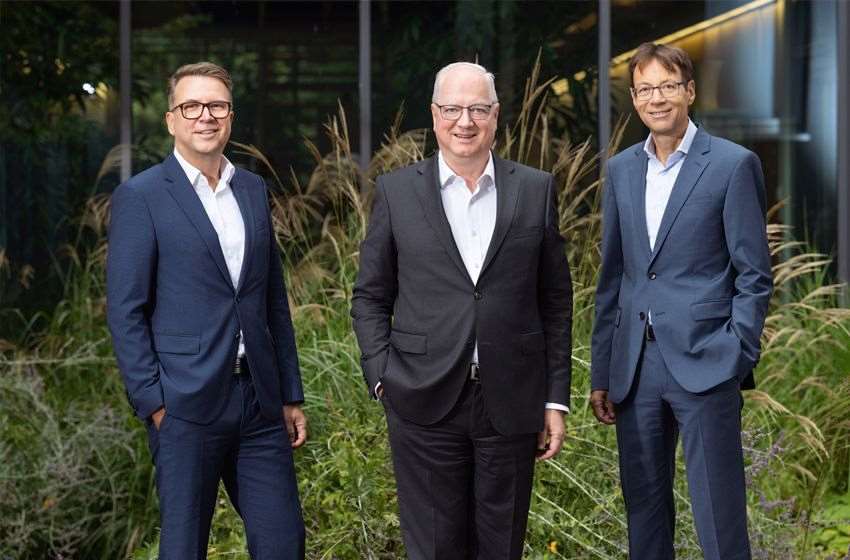
Group Executive Board as of 31 December 2025 (from left to right): Marc Haller, Alois Waldburg-Zeil, Gerold Brütsch
4. Group Executive Board
4.1 Members of the Group Executive Board
As of 31 December 2025, the composition of the Group Executive Board was as follows:
4.2 Professional background, other activities and vested interests
Alois Waldburg-Zeil
Alois Waldburg-Zeil, Dr iur., born in 1963 and Austrian national, joined CPH Group in 2010 as Head of Zeochem and has been CEO/Chairman of the Group Executive Board in tandem since 2025. He is member of the Board of Directors of Canexis Pharma AG, Schlattingen.
From 1997 to 2009, he held various management positions at the Süd-Chemie Group, which is now part of Clariant. His roles included Head of the Office of the Executive Board and Public Relations, Sales Manager EMEA, Global Financial Manager of the Süd-Chemie Performance Packaging Division, Paris (FR), Managing Director of Süd-Chemie Great Britain, Manchester (GB), and Managing Director of Süd-Chemie Zeolites GmbH, Bitterfeld (DE); from 1993 to 1997, he worked in auditing services at KPMG.
Gerold Brütsch
Gerold Brütsch, B.Sc. in business administration, Swiss certified auditor, US Certified Public Accountant, born in 1966 and Swiss national, has been CFO of CPH Group since 2022.
From 2024 to 2025, Gerold Brütsch was also CFO of Perlen Industrieholding AG, Perlen. From 2000 to 2021, he was Group CFO, Head of Corporate Center and Deputy CEO of Starrag Group Holding AG, Rorschacherberg; from 1997 to 1999, he was in charge of finance, controlling, IT and administration at Muller Martini Buchbindesysteme AG, Felben-Wellhausen; and from 1990 to 1997, he was account manager and auditor at KPMG in Zurich and San Francisco.
Marc Haller
Marc Haller, business economist FH, EMBA, born in 1970 and Swiss national, joined CPH Group in 2022 as Head of Perlen Packaging.
From 2007 to 2020, he held various management positions at the Sulzer Group and was a member of the Sulzer Management Group. From 2016 to 2020, he was member of divisional management for Applicator Systems and CEO of Sulzer Mixpac AG, Haag; from 2014 to 2016, he was Senior Vice President Strategy and Business Development at Sulzer Chemtech AG, Winterthur; from 2007 to 2013, he was Global Head Sales and Marketing at Sulzer Mixpac AG, Haag; and from 2000 to 2007, he was Head Sales and Marketing at Plaston AG, Widnau.
4.3 Rules in the Articles of Incorporation governing the number of permissible activities pursuant to Art. 626 para. 2 no. 1 CO
According to Art. 21 of the Articles of Incorporation, members of the Group Executive Board may hold up to five additional mandates, only one of which may be in a listed company. These restrictions do not apply to:
- Mandates in legal entities that are controlled by the company or control the company.
- Mandates in associations and foundations as well as employee welfare foundations. Each member of the Group Executive Board may hold up to five such mandates.
- Mandates in joint ventures involving the company that are not controlled by the company. Each member of the Group Executive Board may hold up to five such mandates.
Mandates include activities of members of the Group Executive Board in the supreme management or administrative bodies of legal entities that are required to be entered in the Swiss commercial register or a corresponding register abroad, and that are not controlled by the company or do not control the company. Mandates in different legal entities under joint control count as one mandate. No member of the Group Executive Board holds more than the maximum number of external mandates stipulated in the Articles of Incorporation.
4.4 Management contracts
No management contracts have been concluded with companies or natural persons outside of CPH Group.
5. Remuneration, shareholdings and loans
The remuneration and shareholdings of the members of the Board of Directors and Group Executive Board, as well as the responsibilities and the procedure for determining them, are set out in the remuneration report of the annual report 2025.
6. Shareholders’ participation rights
6.1 Restrictions on voting rights and proxy voting
Each registered share has one vote at the General Meeting of CPH Group. There are no restrictions on voting rights.
According to Art. 9 of the Articles of Incorporation, each shareholder may be represented at the General Meeting with a written power of attorney, either by a third party or by the independent proxy. Shareholders of the company have the option of authorizing the independent proxy for each General Meeting in writing or via the Sherpany platform (www.sherpany.com).
6.2 Quorums required by the Articles of Incorporation
The General Meeting passes its resolutions and conducts its elections by a majority of the shares bearing voting rights cast, unless otherwise stipulated by law. Abstentions as well as unmarked and invalid ballots are not taken into account when calculating the relative majority. Pursuant to Art. 13 of the Articles of Incorporation, elections and votes shall be held by open ballot, unless the Chair or one of the participants requests that they be held in secret.
6.3 Convocation of the General Meeting
Pursuant to Art. 11 of the Articles of Incorporation, the General Meeting is convened in writing by way of a letter to the shareholders or by publication of a notice in the Swiss Official Gazette of Commerce. The invitation shall be issued at least 20 days before the date of the meeting. The invitation to the meeting must indicate the matters to be discussed together with the motions of the Board of Directors and of the shareholders who have asked for a General Meeting to be held or for a particular item to be placed on the agenda (Art. 699 para. 3 CO).
6.4 Adding items to the agenda
According to Art. 11 of the Articles of Incorporation, motions by shareholders representing at least 0.5 % of the share capital or votes must be submitted in writing to the Board of Directors at least 30 days before the General Meeting. Subject to the provisions governing the full shareholders’ meeting, no resolutions may be passed on matters that have not been notified in this manner.
6.5 Entries in the share register
Art. 9 of the Articles of Incorporation provides that those shareholders who are entered in the share register as shareholders with voting rights on the cut-off date designated by the Board of Directors shall be entitled to participate in the General Meeting and exercise their right to vote at the General Meeting.
7. Change of control and defence measures
7.1 Obligation to make an offer
According to Art. 6 of the Articles of Incorporation, when someone purchases CPH Group shares they are not obliged to make a public offer to buy pursuant to the Financial Market Infrastructure Act if a statutory limit is exceeded (opting-out clause).
7.2 Clauses on change control
There are no change of control clauses.
8. Auditors
8.1 Term of mandate and term of office of the lead auditor
PricewaterhouseCoopers AG, Zurich, has been the statutory auditor of CPH Group since 1971. Norbert Kühnis has been the lead auditor since the 2023 financial year. According to Art. 730a para. 2 CO, the lead auditor is changed every seven years.
8.2 Auditing fees and other fees
The following fees were paid to the auditors:
Auditing fees comprise auditing services performed each year in order to provide a judgment on the consolidated financial statements and to prepare reports on the financial statements of the group companies as required by local law.
8.3 Information instruments pertaining to the external audit
The Finance, Auditing and Sustainability Committee assesses the performance, independence and remuneration of the external auditors. It approves the audit plan, handles the audit reports and monitors implementation of the recommendations made by the external auditors.
The committee reports annually to the Board of Directors. In the reporting year, the representatives of the auditors attended all meetings of the Finance, Auditing and Sustainability Committee for the agenda items concerning them.
9. Information policy
9.1 Information tools
CPH Group maintains a culture of open communication with employees, shareholders and the public. The company publishes an annual report as of 31 December and a half-year report as of 30 June. A short version of the annual report is sent directly to shareholders in printed form. The report can be ordered at https://cph.ch/investors/documentation/.
Written notifications by the company to shareholders in the cases prescribed by law shall be sent to the address of the shareholder or authorized representative last entered in the share register.
The “Investors” section of the website https://cph.ch/investors/ contains all information for shareholders and investors, such as the financial calendar, the company’s key figures or the current share price. The company can be contacted via the email address info@cph.group. Interested parties can sign up on the website https://cph.ch/investors/ir-contacts to automatically receive notifications from the company by email. Published ad hoc announcements are uploaded on an ongoing basis at https://cph.ch/media/ad-hoc-news/ and other media releases at https://cph.ch/media/communications/. An analyst and media conference is held when the annual financial statements are released.
Information on Zeochem and Perlen Packaging can also be found on their respective websites at zeochem.com and perlenpackaging.com. Zeochem additionally operates the website www.zeotope.com for deuterated products. CPH Group and its companies have their own social media profiles on LinkedIn at the following addresses:
9.2 Information for shareholders
The closing price of the CPH share on SIX Swiss Exchange on 30 December 2025 was CHF 69.20, compared to CHF 73.40 in the previous year. As a result, the performance of the CPH share was 5.7 % below the overall market, which increased by 14.2 % as measured by the Swiss Performance Index Price (SPIX).
CPH share price performance 2021–2025
Compared to the SPIX in CHF
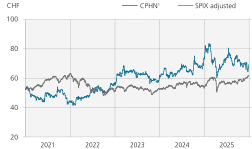
1 Adjusted for the indicative share determined for the separated-off Perlen Industrieholding AG of around 28 % (based on internal valuations).
Share statistics
1 Board of Directors’ proposal to the Annual General Meeting of 17 March 2026
2 adjusted for the indicative share of around 28 % of the spun-off Perlen Industrieholding AG
3 continued divisions; derived from the consolidated financial statements and accounting records 2021 to 2024
4 Share from continued divisions based on share of earnings per share
5 continued divisions, see also footnote 2, 3, and 4
9.3 Investor relations calendar
- 18 February 2026 Media and investor conference, publication of annual report 2025
- 17 March 2026 General Meeting (Lucerne)
- 21 July 2026 Half-year report as of 30 June 2026
- 10 September 2026 Investors’ Day of CPH Group, Zurich
- 18 February 2027 Media and investor conference, publication of annual report 2026
- 16 March 2027 General Meeting (Lucerne)
9.4 Investor relations contact
Gerold Brütsch, CFO
Phone: + 41 41 455 87 67
Email: investor.relations@cph.group
10. Blackout periods
Members of the Board of Directors and Group Executive Board of CPH Group, as well as internal and external employees who are involved in preparing the annual and half-year financial statements, may not trade any securities whose value is heavily dependent on the performance of CPH shares for a period starting no later than the first day of December or June prior to announcement of the respective financial statements and continuing for 48 hours thereafter. No exceptions to the above blackout periods were granted during the reporting year. Special blackout periods may be implemented for projects. The rules set out in the “Regulations on the disclosure of management transactions and the ban on insider trading” also apply, which can be downloaded from https://cph.ch/investors/documentation/ under the section “Articles of Incorporation, regulations and description of duties” (available only in German).